Science taught by a working scientist
Too often, science is taught as a set of facts to memorise. That approach might scrape a pass, but it does not produce the understanding needed for higher grades or for A-Level study. I teach the sciences as interconnected disciplines built on observation, logic, and evidence, because that is what they are and how I practise them.
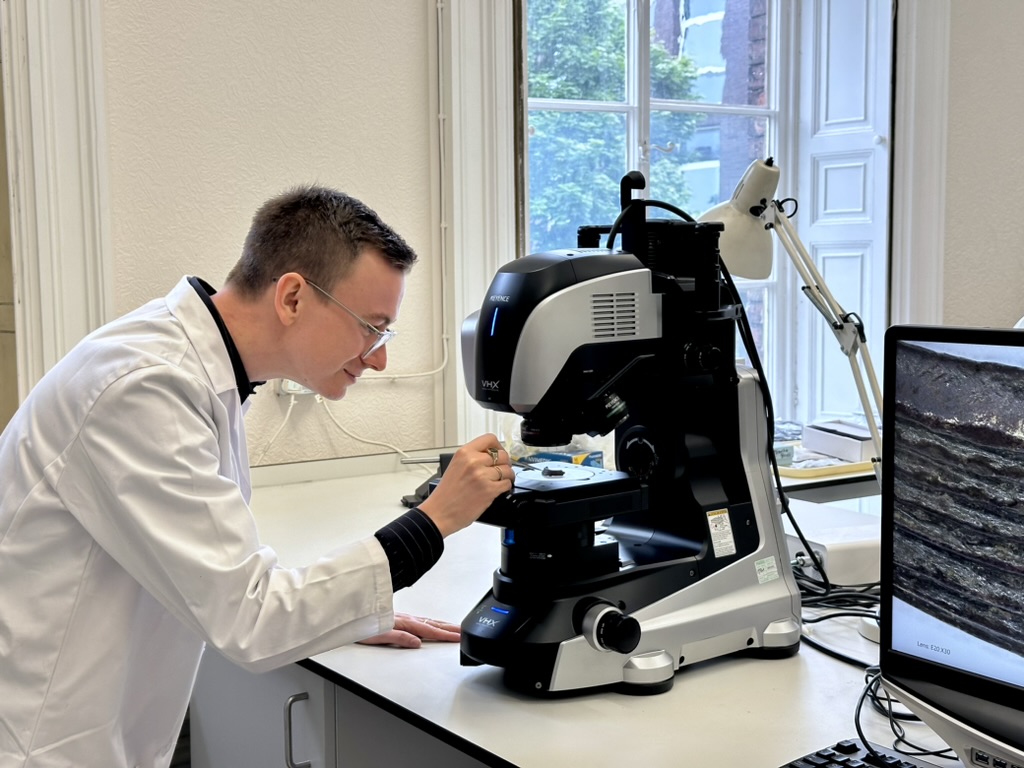
My doctoral research in Scientific Archaeology sits at the intersection of all three sciences. I analyse ancient materials using optical and electron microscopy (physics), investigate their chemical composition through spectroscopic techniques (chemistry), and study biological processes such as wood degradation and organic preservation (biology). This means that when I teach these subjects, I draw on real research experience, not a textbook summary.
At KS3, I build the conceptual foundations that make GCSE study manageable. Topics such as particle theory, forces, cells, and chemical reactions are introduced carefully, with emphasis on understanding the underlying principles rather than learning disconnected facts.
At GCSE, I cover the full range of topics required by the major exam boards, including required practicals and the mathematical skills that increasingly feature in science papers. I teach pupils how to answer the six-mark extended response questions that many find challenging, and I ensure they are comfortable with graph interpretation, calculation, and data analysis.
At A-Level, the depth and mathematical demand increase substantially. I support pupils through the transition, building on GCSE knowledge and extending it into more rigorous territory. Whether the topic is enzyme kinetics, electrochemistry, or wave-particle duality, I ensure that understanding comes before application.